

Fritz Lang — “METROPOLIS” (メトロポリス) Ultra‑rare original Japanese pre‑war film‑press issue with bound‑in card‑stock Metropolis advertising pamphlet (Robot Maria cover + full double‑page Art‑Deco spread; reads right‑to‑left)
*Please note the price is fixed for this item. It is not included in any of our periodic sales (e.g. Black Friday)!*
Fritz Lang — “METROPOLIS” (メトロポリス)
Ultra‑rare original Japanese pre‑war film‑press issue with bound‑in card‑stock Metropolis advertising pamphlet (Robot Maria cover + full double‑page Art‑Deco spread; reads right‑to‑left)
THE MOVIE TIMES / キネマ旬報 (Kinema Junpō), No. 326 (Spring Special Issue), 1 April 1929
Japan, 1929
Magazine size (closed): 9 × 26.5 cm (approx. 3.5 × 10.4 in)
Metropolis pamphlet (opened to centre spread): 18 × 26.5 cm (approx. 7.1 × 10.4 in)
A truly exceptional survival from the pre‑war Japanese cinema press: a slim, elegant, tall‑format issue of The Movie Times / キネマ旬報—retaining an integral, bound‑in, heavy card‑stock Metropolis advertising pamphlet that functions as a miniature, self‑contained design object within the magazine.
This is the kind of material specialist researchers point to when discussing how Metropolis was promoted in Japan: when large‑format first‑release posters are seldom documented or survive, film magazines and theatre brochures become the primary surviving carriers of the campaign—and the graphic art can be extraordinary.
The Metropolis card‑stock pamphlet in this copy
This is not a simple paper advert on magazine stock. It is a card‑stock insert/pamphlet, bound into the issue, designed to be handled as its own miniature programme‑like piece:
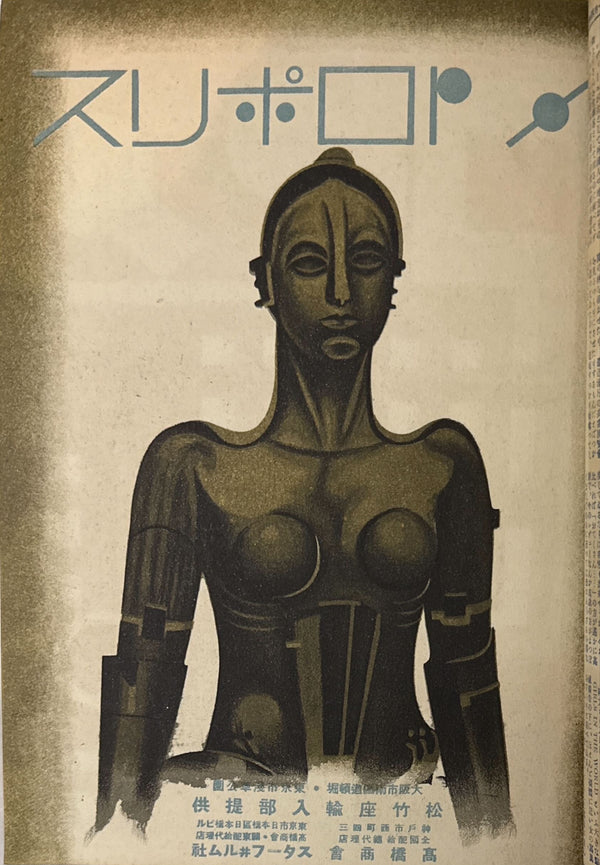
1) Card‑stock front: Robot Maria (cover image)
The first card‑stock page presents the robot woman in a dramatic, stylised halftone—cool, symmetrical, and unmistakably modern—beneath a band of geometric katakana titling. The overall effect is “cinema transformed into design”: severe, elegant, and completely of its moment.
2) Turn the card‑stock page: full double‑page Metropolis spread (card stock; opens to 18 × 26.5 cm)
Opening the pamphlet reveals an extraordinary, fully realised Art‑Deco / modernist composition—designed to read right‑to‑left, with bold industrial geometry and futuristic numerals. The layout combines:
-
monumental katakana letterforms engineered into discs, bars, and blocks
-
machine‑age motifs (targets, grids, gauges, architectural massing)
-
large “future” date markers integrated as graphic devices (including 1929 and 2029)
-
the title rendered with striking typographic presence (including “METRO…OLIS” in Roman letters at the base)
The result reads like a poster—except it survives as a bound‑in, card‑stock centrepiece.
3) Card‑stock reverse: blue‑toned montage page
The reverse side (as photographed) presents a blue‑toned montage of imagery in circular vignettes—figures, machinery, and towering set/architectural forms—reinforcing the film’s city‑and‑machine aesthetic in a markedly different visual register.
Historical context: Metropolis arrives in Japan
Specialist research records that Metropolis premiered in Tokyo on 3 April 1929 (two years after the Berlin premiere), and suggests the version shown was likely the Paramount‑released edit associated with Channing Pollock rather than the longer UFA director’s cut.
The same research describes a complicated path to release in Japan—promotion as early as 1928, rights disruption, and eventual April release arrangements—before continued exhibition during 1929.
Within that context, surviving press‑borne material like this issue becomes especially important: it is exactly the kind of primary evidence that preserves the look and language of Japan’s original Metropolis marketing.
Rarity: pre‑war Japanese Metropolis paper is genuinely scarce
MUBI’s Notebook notes that a “trove” of Metropolis art expanded when two very rare Japanese chirashi flyers and a program booklet appeared at auction—produced for the 1929 Japanese release—praising their Deco designs, rich colour, and modernist lettering.
This magazine, with its bound‑in card‑stock Metropolis pamphlet, sits squarely within that rare ecosystem of surviving Japanese release‑era Metropolis design.
Comparative market note (context only)
For perspective on collector demand: specialist research notes that Yahoo Japan Auctions sold an original first‑release Japanese Metropolis poster on 26 May 2014 for ¥1.9 million, described as 45 × 62 cm, offset lithographed, and modernist in design.
Using the USD/JPY rate for 26 May 2014 (1 USD = 101.895 JPY), ¥1.9 million is approximately US$18,647.
(Provided purely as context for the scarcity and market intensity around original Japanese Metropolis material, not as a like‑for‑like comparison in format.)
Condition (based on the photographs provided)
Very good overall for a fragile pre‑war periodical (nearly 100 years old).
-
Cover: strong colour and graphic presence; light edge wear and corner softening; minor surface handling consistent with age; presents exceptionally well.
-
Binding & block: side profile shows a stable, intact magazine with expected age toning at page edges.
-
Metropolis card‑stock pamphlet: all key pages shown (Robot Maria cover; opened double‑page spread; blue‑toned reverse) with bold, clean visual impact; minor age marks/toning consistent with a 1929 paper and board item.
(As always with pre‑war paper, please rely on the photos for granular condition.)
Details
-
Country: Japan
-
Publication: THE MOVIE TIMES / キネマ旬報 (Kinema Junpō)
-
Issue: No. 326 (Spring Special Issue)
-
Date: 1 April 1929
-
Size (closed): 9 × 26.5 cm
-
Key feature: bound‑in card‑stock Metropolis advertising pamphlet, comprising:
-
Robot Maria card‑stock “cover” page
-
full double‑page Art‑Deco Metropolis spread on card stock (opens to 18 × 26.5 cm; right‑to‑left layout)
-
blue‑toned montage reverse page
-