

“A FISTFUL OF DOLLARS” (1964) – ORIGINAL JAPANESE B0 “EKI‑BARI” BILLBOARD / STATION POSTER – JAPAN‑EXCLUSIVE FIRST‑RELEASE ARTWORK Ultra Rare Rarity | Massive Format | Original Japanese Theatrical Release (1967, Tōwa) | c. 100 × 157 cm (G)
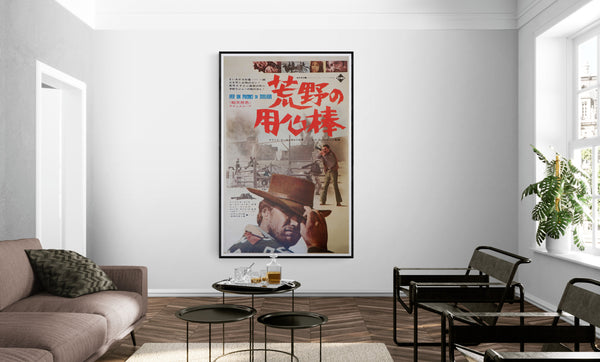
A monumental, original Japanese “billboard / station display” (駅貼り・eki‑bari) poster for Sergio Leone’s A Fistful of Dollars—printed for the 1967 Japanese theatrical release and distributed domestically by Tōwa (the TŌWA mark appears on the sheet). This is not a reproduction—it is an original 1967 Japanese issue, featuring the striking Japan‑exclusive key design used for the film’s first‑release campaign.
Japanese collectors have historically been space‑conscious and often prioritized smaller formats like chirashi (7 × 10 in) and standard theatrical B2 sheets. A huge B0 eki‑bari like this was working advertising—made to be posted in public spaces and then discarded—so survival rates are dramatically lower.
Flash forward to today and this ultra rare B0 for one of the most influential Spaghetti Westerns ever made has become a true grail‑level piece. We have never seen another example of this B0 in Japan—let alone in the West—and we have found no meaningful traces online of this exact billboard sheet.
Date & Japanese Theatrical Release
This is an original Japanese release poster printed in 1967 for the domestic rollout of A Fistful of Dollars (Italian title: “Per Un Pugno di Dollari”), released in Japan via Tōwa.
The Film & Its Place in Cinema History
Sergio Leone’s groundbreaking film launched the Spaghetti Western into global consciousness and introduced Clint Eastwood—in his first leading role—as the cool, amoral drifter later marketed as “The Man with No Name.” Produced on a famously tight budget, Leone’s stark close‑ups, choreographed gunplay, and Ennio Morricone’s unforgettable score redefined the Western.
The film also bears a famous connection to Akira Kurosawa’s Yojimbo (1961)—so close that Toho successfully sued—cementing the title’s place in the history of international film exchange. Many European participants adopted American‑sounding pseudonyms for export prints—Leone as “Bob Robertson”, Gian Maria Volonté as “Johnny Wels,” and Morricone as “Dan Savio.” Along with For a Few Dollars More and The Good, the Bad and the Ugly, it forms the era‑defining “Dollars Trilogy.”
Design Notes
This Japan‑exclusive first‑release design is a masterclass in bold, high‑impact typography and kinetic montage:
Japan title in giant vermillion kanji: 荒野の用心棒 (Kōya no Yōjinbō) surges across the upper half in an aggressive brush‑style treatment
Italian title slug: PER UN PUGNO DI DOLLARI appears prominently in blue
A dramatic photo‑montage: Eastwood tips his hat in the foreground while chaos erupts in a smoky frontier town—perfectly mirroring Leone’s tension‑soaked vistas and moral ambiguity
Top image strip: a tight sequence of stills (hands/gun detail, riders, a woman’s portrait, a hardened close‑up) that reads like a trailer in four frames
Period Japanese tech callouts: 総天然色 and テクニスコープ (full color / Techniscope)
Pseudonym credit detail: the director is billed as “ボブ・ロバートソン” (Bob Robertson)—a classic period feature and a great “deep‑collector” detail on the sheet
The Japanese B0 / BO “Billboard” Format and Why It’s So Hard to Find
Japan’s standard theatrical poster size is B2, and even for major titles, those were produced in comparatively large campaign quantities. The B0 “eki‑bari” billboard/station sheets are a completely different category: giant working advertising intended for short‑term public posting—handled hard, exposed, removed, and typically discarded.
With no official print records available, a realistic collector framework is:
Standard B2 campaign printing: often tens of thousands
B0 eki‑bari station/billboard printing: commonly only the low hundreds (or fewer), distributed by placement sets rather than mass retail-style print runs
That huge gap—combined with extremely low survival—makes B0 eki‑bari pieces for top titles like this wildly scarce today.
Condition Report
Overall presentation: Very Good / Excellent display condition (previously professionally restored (prior to ownership by Japan Poster Shop) & tissue‑backed in Japan).
Conservation / condition summary (high level):
Tissue backing added in Japan for stabilization, flatter display, and long‑term support
Some foxing present (typical age-related spotting for mid‑century paper)
Despite the foxing, the poster presents beautifully with strong color and high visual impact in the key image and title area
Authenticity: Original 1967 Japanese release B0 eki‑bari poster — not a reproduction or modern reprint.
It is over 58 years old!
(Please refer to the image provided—this is the exact poster offered.) Additional imagery available on request.
Please note the price is fixed for this item. It is not included in any of our periodic sales (e.g. Black Friday)!