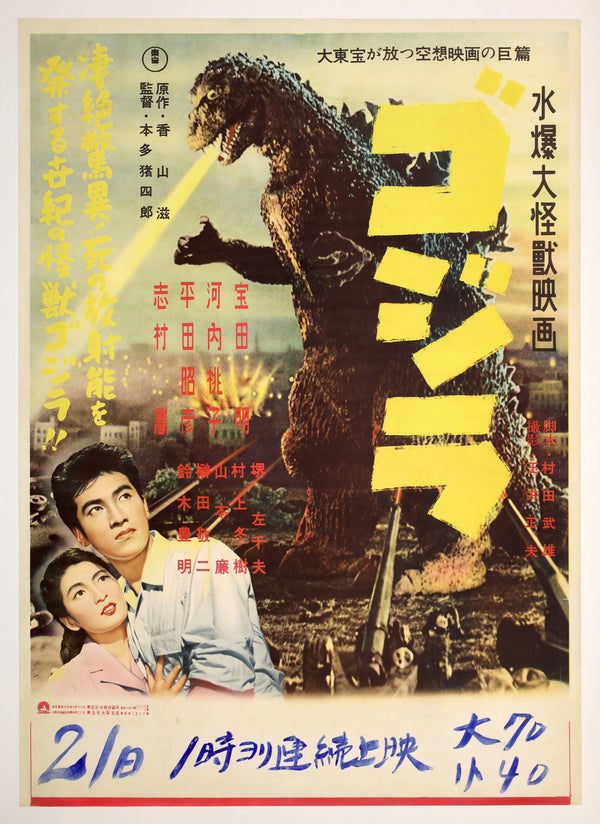


GODZILLA / ゴジラ Japan (Toho), 1954 Original first-release Japanese theatrical poster (B2 / chihōban (地方版), Style B) Colour-printed poster on paper, professionally linen-backed
Sold at Christie’s New York (Asian Art Week), “Anime Starts Here” (Sale 24872) — Price realised: USD 25,400.
GODZILLA / ゴジラ
Japan (Toho), 1954
Original first-release Japanese theatrical poster (B2 / chihōban (地方版), Style B)
Colour-printed poster on paper, professionally linen-backed
A “holy grail” of Japanese kaijū cinema paper: the first-release, country-of-origin regional (“chihōban”) Style B for Godzilla—a sheet whose survival rate places it among the most coveted and elusive Japanese film posters of the Shōwa era.
In our experience, this Style B chihōban variant appears dramatically less often than the familiar Style A design—by an order of magnitude. The result is an object that functions at the very top of the market: the “Toyota 2000GT” tier of Japanese cinema paper (and for many collectors, the ultimate cornerstone monster poster).
“A sheet whose format, variant, and survival rate place it among the rarest Godzilla posters ever to reach collectors.”
Key Facts
-
Film: Godzilla (Gojira / ゴジラ)
-
Director: Ishiro Honda(本多猪四郎)
-
Story (Original): Shigeru Kayama(香山滋)
-
Release: 3 November 1954 (Japan)
-
Poster format: B2 chihōban (地方版 / regional variant), Style B — c. 52.5 × 75 cm (as offered)
-
Conservation: Professional linen-backing for long-term stability and display (details below)
Rarity and Market Context
The chihōban factor: regional paper that almost never survives
“Chihōban” (地方版) posters were regional/theatre-distribution variants—working objects intended for hard use, local display, and disposal. In the case of Godzilla Style B chihōban, it is widely described as exceedingly scarce / impossibly rare, underscoring just how far removed it is from standard studio-issued sheets.
This poster exhibits the kind of “once-in-many-years” visibility that defines institutional-grade rarity in poster collecting—especially for a title as universally pursued as Godzilla.
Ishirō Honda and the Status of Godzilla
A landmark of postwar cinema—and the template for the modern kaijū film
Godzilla is not merely an iconic monster picture; it is widely recognized as a landmark work of Japanese postwar filmmaking, marrying spectacle to cultural anxiety with unusual force.
A defining allegory of the Atomic Age
The film’s anti-nuclear charge is central to its stature. The British Film Institute describes Godzilla as a defining allegory of nuclear horrors—made in the shadow of Hiroshima and Nagasaki, and in the immediate wake of the irradiated fishing-boat incident connected to Bikini Atoll testing.
The 1954 film used Godzilla as a metaphor for the horrors of the bombings, and that the U.S. version was heavily edited to blunt political charge.
From one film to a global phenomenon
Godzilla sits at the root of one of cinema’s most durable mythologies. Guinness World Records recognizes Godzilla as the longest continuously running movie franchise.
The B2 Chihōban Format
Japanese posters exist in multiple standard sizes, but the chihōban variant changes the survival math completely: it was a regional working sheet, frequently used with blank imprint areas for theatre information—exactly the kind of poster least likely to be saved.
This is not just “first release.” It is first release + regional variant + Style B—the collecting trifecta that turns a famous title into a truly ultra-rare object.
Poster Design: A Masterclass in Mid‑Shōwa Kaijū Iconography
This is one of the most powerful compositions in Japanese genre-poster history—graphic, immediate, and unapologetically dramatic:
-
Monumental title typography: the giant, blocky ゴジラ slashes across the sheet in electric yellow—an audacious, modernist intervention that feels almost like painted signage over photographic destruction.
-
The “heat ray” moment: Godzilla’s beam cuts diagonally through the sky—an image that fuses spectacle with the film’s atomic dread.
-
Scale and depth: miniature-city devastation recedes beneath the monster’s torso, giving the sheet extraordinary vertical drama for a B2.
-
Human stakes: the lower vignette of the lead couple anchors the spectacle in human vulnerability—classic studio-era balance between catastrophe and emotion.
Country of origin and studio identity are unmistakably present throughout, anchored by Toho branding and the Japanese copy that frames the film explicitly in atomic terms.
Text and Translation Notes
Below are key on-sheet texts and their English meanings as printed on the poster:
-
Main title: ゴジラ — “Godzilla” (Gojira)
-
Right-side descriptor: 水爆大怪獣映画 — “Hydrogen-bomb giant monster film”
-
Top line: 大東宝が放つ空想映画の巨篇 — “A monumental fantasy epic unleashed by Toho”
-
Left-side yellow tagline:
来た 絶滅目前!死の放射能を浴びる世紀の怪獣ゴジラ!!
“He’s here—Extinction imminent! Bathed in deadly radiation—the monster of the century, Godzilla!!” -
Credits (left, black):
原作・香山滋 — “Story: Shigeru Kayama”
監督・本多猪四郎 — “Director: Ishiro Honda” -
Credits (right, red):
脚本・村田武雄 — “Screenplay: Takeo Murata”
撮影・玉井正夫 — “Cinematography: Masao Tamai” -
Principal cast highlighted in red:
宝田明 / 河内桃子 / 平田昭彦 / 志村喬
(Akira Takarada / Momoko Kōchi / Akihiko Hirata / Takashi Shimura)
Period exhibitor notation: the lower blank margin bears contemporary show-information in blue paint/ink, including “1時ヨリ連続上映” (“Continuous screening from 1 o’clock”) and pricing “大70 / 小40” (adult/child), a hallmark of real-world theatrical use for this format.
Conservation
Professional linen-backing for long-term stability
This poster has been professionally linen-backed to ensure structural stability for handling, long-term preservation, and display.
Condition
Near mint presentation on linen. Prior to linen-backing, the poster showed minor edge wear and signs of use consistent with a working regional theatrical sheet. Expert stabilization/restoration has addressed these issues, and the poster now presents clean, vibrant, and display-ready, with strong colour saturation and excellent overall eye appeal.
The period show-information in the lower imprint area (blue) is retained as an authentic trace of original use and is consistent with how this format was employed in cinemas.
Please review the provided photos — they show the exact poster offered.
Certificate of Authenticity
Certificate of Authenticity included.
*Please note the price is fixed for this item. It is not included in any of our periodic sales (e.g. Black Friday)!*