

“Sleeping Beauty” (眠れる森の美女), Original Japanese Re-Release Movie Poster 1970, Ultra Rare, Conservation Linen-Backed, STB Tatekan Size 20 × 57 in. (51 × 145 cm)
A spectacular 1970 Japanese re-release STB tatekan for Walt Disney’s Sleeping Beauty—and one of the most visually striking Japan-only poster designs created for this landmark animated feature. Printed in the exceptionally scarce tall-format STB / tatekan size, this poster stands nearly five feet high and represents a rare surviving example of a display format produced in very limited numbers for theatrical exhibition.
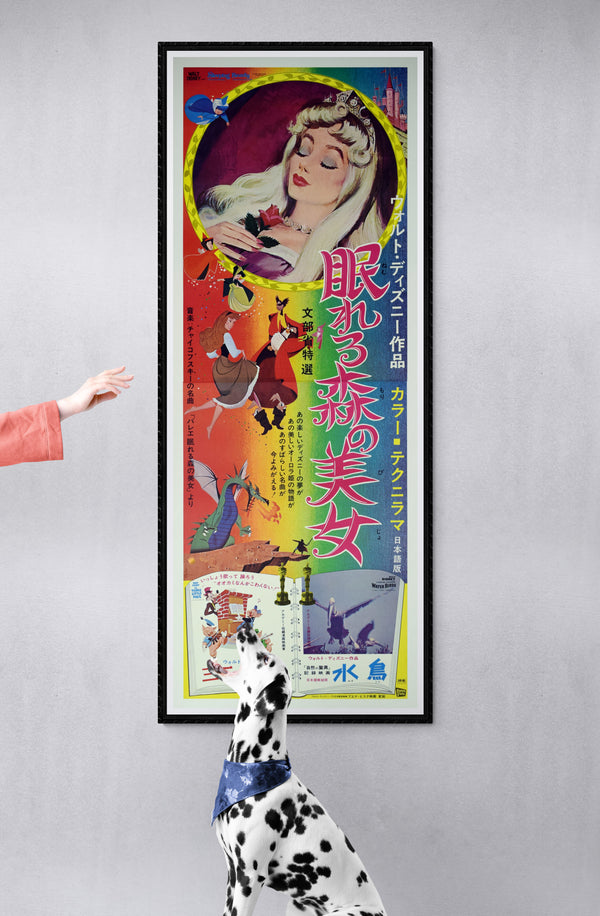
Visually, it is one of the most beautiful Sleeping Beauty posters of any country: Princess Aurora appears in a large circular portrait at the top, rendered with soft, elegant mid-century colouring, while the surrounding composition bursts with the full fantasy world of the film—Flora, Fauna, Merryweather, Prince Phillip, Maleficent, Diablo, the dragon, and the castle all arranged in a uniquely Japanese vertical design. The oversized red-and-white Japanese title 眠れる森の美女 runs dramatically down the centre, giving the poster extraordinary presence and unmistakable display impact.
This is a poster with exceptional collector significance: most STB tatekan posters were intended for short-term cinema use, mounted to standing boards, and discarded immediately after the run. Very few were ever preserved, and examples of this title in this size are seldom seen. To our knowledge, this poster is one of the very few surviving examples and has not appeared publicly in any major auction in either the West or Japan.
Date & Japanese Theatrical Release
Sleeping Beauty premiered in the United States in 1959.
This is an original 1970 Japanese re-release poster, issued for a later Japanese theatrical presentation of the film and now over 55 years old.
Unlike standard poster formats, this example was printed in the rare STB tatekan standing-display size, measuring approximately 20 × 57 inches / 51 × 145 cm. Its elongated vertical format was designed specifically for prominent cinema display, making survival in this condition especially unusual.
The Film & Its Place in Disney’s Legacy
Produced by Walt Disney Productions, Sleeping Beauty is Disney’s sixteenth animated feature and one of the studio’s most ambitious fairy-tale productions. Based on the classic tale by Charles Perrault, the film was released by Buena Vista Distribution in 1959 and became the final Disney fairy-tale feature produced during Walt Disney’s lifetime.
The film features the voices of Mary Costa, Eleanor Audley, Verna Felton, Barbara Luddy, Barbara Jo Allen, Bill Shirley, Taylor Holmes, and Bill Thompson. Its music, adapted from Pyotr Ilyich Tchaikovsky’s Sleeping Beauty ballet, was arranged by George Bruns and performed with the Graunke Symphony Orchestra.
Historically, Sleeping Beauty holds a major technical place in animation history as the first animated feature photographed in the Super Technirama 70 widescreen process, and one of Disney’s great achievements in design, colour, and cinematic scale. Its reputation has grown considerably over time, and in 2019 the film was selected for preservation in the United States National Film Registry as being culturally, historically, or aesthetically significant.
Design Notes
Large Aurora portrait: the upper section is dominated by a beautiful close-up image of Princess Aurora sleeping, framed within a yellow circular border. The composition gives the poster an unusually elegant, dreamlike quality, perfectly suited to the film’s fairy-tale atmosphere.
Japan-only vertical title treatment: the massive Japanese lettering 眠れる森の美女 runs down the centre-right of the poster in bold red and white, creating a powerful graphic anchor and transforming the title into one of the main visual elements of the design.
Full character montage: the poster incorporates nearly the entire fantasy world of the film, including Aurora, Prince Phillip, Flora, Fauna, Merryweather, Maleficent, Diablo, the dragon, and the distant castle—an unusually rich composition that captures both the romance and danger of the story.
Maleficent and dragon imagery: the lower section features Maleficent’s dragon form breathing fire toward Prince Phillip, giving the poster dramatic contrast against the softer portrait of Aurora above.
Additional Disney programme artwork: the bottom portion promotes accompanying Walt Disney shorts, including Three Little Pigs and Water Birds, presented in a charming open-book layout that adds further period character and makes the poster distinctly tied to its Japanese theatrical programme.
Japanese colour and layout: the rainbow-toned background, vertical typography, and dense character arrangement are highly characteristic of Japanese theatrical advertising from the period, while remaining completely different from American and European campaign designs.
Disney, Technirama, and the Japanese Release Pitch
The Japanese text identifies the film as a Walt Disney production and promotes it as a colour Technirama Japanese-language presentation. The poster also highlights the music by Tchaikovsky, directly referencing the famous ballet source that shaped the film’s score.
The design reflects the Japanese market’s distinctive approach to Disney advertising: rather than relying on a single Western key-art image, the poster presents the film as a complete visual experience, combining romance, fantasy, music, spectacle, and character montage in one dramatic vertical composition.
About STB / Tatekan Posters
Japanese STB / tatekan posters were tall standing-board advertisements, usually printed in two separate pieces and pasted together vertically for cinema display. They typically measure around 20 × 58 inches, making them much taller than standard Japanese B2 posters.
Because they were created for prominent theatrical use rather than long-term preservation, most were mounted, displayed, damaged, and discarded after the film’s run. Survival rates are therefore dramatically lower than for standard poster formats, particularly for Disney titles. This makes original STB examples among the most desirable and difficult-to-find Japanese movie posters.
Condition Report
Overall condition: fantastic, especially for a rare 1970 Japanese STB tatekan poster of this size.
This poster has been conservation linen-backed to ensure long-term stability and preservation for future generations. It was sent from Tokyo to professional linen-backers in California, where the work was completed to an exceptional standard.
Please refer to the images—this is the exact poster for sale. It is not a reproduction or reprint.
A Certificate of Authenticity is included.