

392 products
Japanese Contemporary Art & Graphic Design Posters
Explore Japan Poster Shop’s extensive collection of original Japanese contemporary art posters, vintage graphic design and rare postwar Japanese visual art, featuring historically significant works by some of Japan’s most influential artists and designers.
Japanese graphic art underwent an extraordinary transformation during the second half of the twentieth century. Emerging from the country’s postwar cultural and economic revival, a new generation of artists developed an unmistakable visual language that combined traditional Japanese aesthetics, ukiyo-e, modernism, surrealism, psychedelia, pop art, experimental typography and avant-garde artistic expression.
The result was one of the most inventive periods in the history of graphic design, producing original posters that continue to be celebrated by museums, collectors and design historians around the world.
Our collection encompasses rare original Japanese art posters, exhibition posters, theatre advertising, psychedelic designs, avant-garde graphic works and distinctive promotional artwork, spanning the postwar period through to contemporary Japanese visual culture.
Particularly important is the work of Tadanori Yokoo (横尾忠則, born 1936), one of Japan’s most celebrated living artists and a defining figure in postwar graphic design.
Yokoo’s extraordinary compositions combine traditional Japanese imagery, rising-sun motifs, saturated colour, photographic collage and surrealist symbolism. His influential posters from the 1960s and 1970s helped establish graphic design as a powerful form of artistic expression, bridging the worlds of fine art, theatre, music and popular culture.
Japan Poster Shop holds an exceptionally extensive collection of original Tadanori Yokoo posters, including rare early designs, original theatre advertising, exhibition posters and historically significant examples of Japanese psychedelic graphic art.
Another central figure is Keiichi Tanaami (田名網敬一, 1936–2024), whose psychedelic and pop-influenced imagery transformed the visual language of Japanese commercial art. Drawing inspiration from American pop culture, manga, wartime memories and surrealist traditions, Tanaami developed a distinctive body of work spanning graphic design, painting, animation and experimental art.
Our collection also includes works associated with Kiyoshi Awazu (粟津潔, 1929–2009), a pioneering Japanese graphic designer whose influential posters combined experimental typography, illustration, photography and socially engaged visual communication.
Awazu played an important role in the development of modern Japanese graphic design, creating celebrated works for theatre, cinema, exhibitions and cultural institutions.
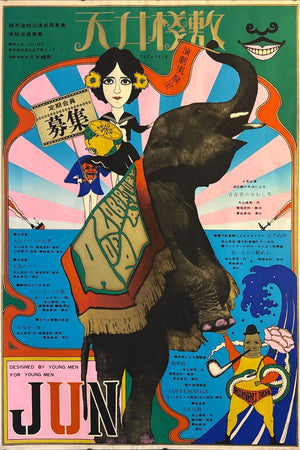
Aquirax Uno (宇野亞喜良, born 1934) is another major figure represented within our holdings. Renowned for his elegant, dreamlike illustrations and distinctive portrayals of the human figure, Uno created some of the most recognisable Japanese theatre and advertising posters of the postwar era.
His work is particularly associated with the experimental theatre movement, where his sophisticated compositions and imaginative imagery contributed to the visual identity of Japanese avant-garde performance.
The collection also features work associated with Seiichi Hayashi (林静一, born 1945), the influential artist, illustrator and manga creator whose distinctive visual style combines traditional Japanese aesthetics with modern graphic sensibilities.
Hayashi’s work occupies an important position at the intersection of manga, illustration, animation and fine art, reflecting the remarkable diversity of Japanese visual culture.
Beyond these celebrated artists, our wider collection explores the relationship between Japanese graphic design, experimental cinema, theatre, music, advertising, animation and contemporary art, demonstrating how the printed poster became an important artistic medium in its own right.
Many original Japanese art posters were produced for specific exhibitions, performances or temporary advertising campaigns rather than for conventional retail distribution. Their ephemeral nature, limited circulation and the passage of time have contributed to the scarcity of surviving examples.
Original period printings, particularly from the 1960s and 1970s, are highly sought after by collectors of Japanese postwar art and graphic design. Certain historically important designs are exceptionally difficult to acquire, particularly in well-preserved condition.
Japan Poster Shop has assembled a substantial specialist collection through years of sourcing and collecting within Japan, including acquisitions from established dealers, private collections and specialist networks.
Our holdings include rare original exhibition posters, vintage Japanese psychedelic art, avant-garde theatre posters, distinctive large-format works and historically significant examples of Japanese graphic design.
These pieces are not simply decorative prints. They represent important artefacts of twentieth-century Japanese artistic and cultural history, documenting the development of modern visual communication and the extraordinary creativity of Japan’s postwar artistic movements.
Every poster offered by Japan Poster Shop is an authentic original, individually researched, catalogued and photographed, with attention to printing history, condition and provenance.
We do not sell modern reproductions. All posters are accompanied by a Certificate of Authenticity, with worldwide DHL Express shipping available from our gallery in Tokyo.
Our collection is available to private collectors, galleries, museums, design enthusiasts and institutions, with private viewings available by appointment at our Japanese poster gallery in Shibuya, Tokyo.